Showing posts with label sociology. Show all posts

Friday, March 8, 2019

The Five: The Untold Lives of the Women Killed by Jack the Ripper, by Hallie Rubenhold. Houghton Mifflin Harcourt, 2019


In 1888, five women were killed by the person who would be called Jack the Ripper. The killings were horrific- they weren’t just killed, but disemboweled- and the newspapers of the time made a mint writing sensational stories about them. They characterized the women as ‘prostitutes’, and nothing more was known about them. The image was that they were out on the street and were slain while working. In reality, while all the women were frightfully poor, only one was a sex worker, and she was killed in her bed at home.


The author brings the five women to life. I was amazed at how much could be learned about these women from existing records. Census records, records in the old workhouses, prison records, pension records, ledgers for various businesses, military discharge papers, school records, registers of births, deaths, and weddings- she must have spent a huge amount of time, combing through these primary resources. Then a huge number of books that were about conditions in Victorian days, which painted the backdrop for the lives of these women. It turns out that they led hard lives; that they had been homeless at times and had to sleep outside, they had been in workhouses, that they were all victims of alcoholism, and that society was pretty much set up against them from the start. The poor rarely had access to schooling, so jobs other than manual labor were closed to them. Women were paid very little for their labor; they almost had to have a man for the income if they wanted to live inside. If their man cheated, beat them, spent all the money on alcohol, or left them, they were up creek. One of the women *did* have a man, but on her last night there was only enough money for one of them to sleep inside, and it was her turn to sleep outside.


This book portrays them women who didn’t always make the right choices, but they had precious few to choose from. They had all the hopes, dreams, and cares that everyone has; they were not just put on earth to be victims of the Ripper. It’s about time they are shown to be human beings. ‘The Five’ does this admirably.


Tuesday, February 26, 2019

Nickel and Dimed: On (Not) Getting by in America, by Barbara Ehrenreich. Metropolitan/Owl Books, 2001


Way back in 1998, author Ehrenreich decided to go and try and live like the lower class did. Allowing herself a car and a $1000 in startup money, she went out to land a working class job- waitress, hotel maid, house cleaner, nursing home aide, Walmart associate- and survive on the wages. She discovered how wages didn’t cover rents, or much food, or any way to relax. Most people were working two or even three jobs just to survive. Most often, there was no affordable housing near any source of employment, and there was no affordable transportation. If a worker got ill or injured, they had no option other than to just keep on working. The working class can’t afford to miss work, even if the doctor visit was covered by insurance- and it usually wasn’t back then. Affordable child care simply didn’t exist.


Of course, she wasn’t stuck in this situation. She could tap out at any time and go back to her normal existence. She didn’t live with the knowledge that she would have to live this existence for the rest of her life, with no vacation, no retirement. So she didn’t develop the despair and depression that plagues so many working class people. But she noticed it and reported it. Many people have torn down the author for ‘slumming’, because she could leave, but I feel she wrote an important book because many people were unaware of the situation the working class faced. One person could scarcely cover the entire problem. I did find some things irritating- her fear that she wouldn’t be able to ‘pass’ as a working class person, that her education would out her. Guess what- not every working class person speaks poorly, and there are such things as libraries that allow even the poor to read. One thing that I feel is important about this book is that it showed to the upper classes (if they choose to read it- hah) that even one of their own, a hard working educated woman, couldn’t make it in the system. So much for calling the working class ‘lazy’!


These days, there is a lot more awareness of the problems of the working poor- but I’m not sure there is any more being done about it. Rents are higher, gasoline costs are higher, but wages are the same as they were 20 years ago. There are still huge numbers of people without health insurance. Perhaps it’s time for a reissue of this book, with an update? Five stars.

Saturday, December 15, 2018

Prius or Pickup? How the Answers to Four Simple Questions Explain America’s Great Divide, by Marc Hetherington & Jonathan Weiler. Houghton Mifflin Harcourt, 2018


Hetherington & Weiler put forth the theory that there are two types of people: fixed, and fluid. The fixed have a world view of danger: people and nature are out to get them. Fluid folks, on the other hand, find the world a delightful place to explore, filled with good people. Fixed people drive giant four wheel drive pickups or Hummers, keep big dogs, and prefer plain coffee from Dunkin Donuts over fancy Starbucks concoctions. Fluid folks drive small cars that are less damaging to the environments, like cats, and love trying new cuisines. Oh, and fixed people tend to live rural, while fluids congregate in the city. Most people are NOT pure forms of either, but land somewhere in the middle of the spectrum. Now, there is nothing wrong with being on either end of the spectrum, but… in America, these tendencies are being used by the major parties to divide people and gain support. This is what’s behind the growing chasm between Democrats and Republicans. The Republican Party stresses the dangers in the world, and that they are the only candidates that can protect the people of the USA; Democrats try to say they are supporting programs like the ACA that will benefit all classes. Now, this is a broad brush to paint the political/sociological scene with, but it seems, in most cases to be true.


And it’s getting worse- the two sides don’t get together very often. If the fixeds and the fluids worked together, partied together, went to school together, they would learn that the other side isn’t really the bunch of idiots they think they are. Hard to do when the Powers That Be try to demonize the other side.


Are they right about this? Yes, I think- partly. The chasm between sides is getting worse every day. And it’s obvious that the divide is being used by said Powers That Be. Is it quite as simple as that? Well, no, I don’t think so. There are a lot of other things affecting the world. But this book is a great start to understanding the problems. The one problem I see is that the authors are clearly biased towards one side; it happens to be the side I mostly fall into, but it’s going to make it harder for the side they are against to take the book seriously. Four stars.

Friday, November 23, 2018

God is in the Crowd: Twenty-first Century Judaism, by Tal Keinan. Spiegel & Grau, 2018


This is a hard book to categorize. The first part is autobiography; Keinan was raised in the US and went to school here, but then moved to Israel and joined the Air Force. He was the only non-Israeli fighter pilot there. After his time with the military, he became a financial man as well as chairing a nonprofit that lends to projects including ones by Israeli Palestinians. The next section explores what he feels is a crisis in Judaism. Many US and European Jews are marrying outside the faith, and not raising their children as religious Jews. If that continues, he sees the end of Judaism as it’s known- and been known- for centuries. Judaism survived the Diaspora, pogroms, and the Holocaust only to face extinction by marrying out. His proposed cure for this is program that would fund (via voluntary donations by members) long term camps for Jewish youth, wherein they would spend one year in America and one in Israel, learning the culture of whichever one they didn’t grow up in; it would also pay for the college education of the children. He also proposes that the president of Israel (largely a ceremonial position at this point) be given power over all Jewish religious affairs- a sort of Pope for Judaism- and that the president be elected by *all* Jews the world over, not just Israelis. Right now, Israel has religious issue being adjudicated by ultra-Orthodox Jews, while American Jewry is composed mainly of Reform and Conservative Jews. He feels that the wisdom of the crowd- having all branches of Judaism involved- will save, even though it may change it, Judaism. He doesn’t seem to take sides in a right/left battle; he’s fairly even handed. It is an interesting look into what’s happening to Judaism. Three and a half stars. 

I received this book free from the Amazon Vine Program in return for an unbiased review. This did not affect my opinions. 

Wednesday, March 14, 2018

My Father’s Wake: How the Irish Teach Us How to Live, Love, and Die, by Kevin Toolis. Da Capo Press, 2017


Kevin Toolis has experienced a lot of deaths. As a child, he caught TB and was put in an adult ward of men with various lung diseases- cancer, TB, black lung, a veritable buffet of death. He grew up in rural Ireland, where traditional death customs linger on. His brother died as a very young man- after receiving a bone marrow transplant from the author. As a journalist, he witnessed death in war zones. He has been virtually steeped in death. But it wasn’t until he went home for his father’s death that it all came together for him.


As his father lay dying, the whole extended family, friends, and neighbors started showing up, to stay through his death, wake, and funeral. They spoke with Sonny before he died, they washed and dressed his body after, and they kissed him in his coffin. Endless tea and sandwiches were consumed. Everyone, from old folks to young children, participated. Death, in this village, was an everyday occurrence, not something to be hidden away. Deaths occurred at home, not in a hospital. The body was not whisked away to a mortuary. This, he says, is the way it should be. We all die; why should it be hidden away? Why can’t we once again normalize it, like weddings and birthdays and all those other landmarks of life?


Alternating the course of his father’s death, wake, and funeral with essays on death in other circumstances, it’s not a feel good book. It’s a thoughtful look at a sad subject- there are sections that brought tears to my eyes. But it’s a book on a subject that our society needs to think about these days. Four stars.


The above is an affiliate link. If you click through and buy something- anything- from Amazon, they will give me a few cents. 

I received this book free from the Amazon Vine program in return for an unbiased review. 

Neither of these things influenced my review. 

Monday, December 18, 2017

Victorians Undone: Tales of the Flesh in the Age of Decorum, by Kathryn Hughes. Johns Hopkins University Press, 2017, 2018


While the title sounds risqué, the book itself is not. While the book goes off on many tangents, the main focus is on five people- and, more specifically, specific parts of their bodies.

We start with Lady Flora’s belly. Lady Flora was a lady in waiting to Queen Victoria’s mother. Victoria and her mother were *not* close; the Duchess of Kent thought she and her ‘friend’, Sir John Conroy, should reign as regents for five years, even though Victoria had reached 18, the age of majority. Victoria would have none of that, and she pushed her mother away hard. When the unmarried Lady Flora’s belly begin to swell, it was another wedge between the two royal women. Flora swore she was a virgin, and, yet, her belly got even larger as she lost weight on the rest of her body. Flora was forced to undergo intimate examinations by physicians, who swore she was still a virgin. More than nine months passed. In any other situation, people would have accepted that Flora was desperately ill rather than pregnant, but this was the Victorian era and Victoria hated Flora. After her death, her family had an autopsy done, with numerous doctors present, to prove there was no child inside flora and that there never had been. Why was everyone so obsessed with this? I guess because they had no soap operas back then.

After that we have Charles Darwin’s beard (which wanders through how human females go about selecting acceptable mates), George Eliot’s hand (supposedly her right hand was significantly larger than her left, due to manual labor as a child in the family dairy), Fanny Cornforth’s mouth (a model for Dante Gabriel Rosseti as well as being his mistress-a role she played with many other men, too) that goes over prostitution in the Victorian era, and the tragic murder of little Fanny Adams, a child who was cut into pieces which were found strewn about a park.

It’s mostly a very interesting book- it’s full of information about the Victorian era, mostly focusing on how they thought about the fact that humans are animals with bodies that ached, pained, belched, farted, and could show what their lives were like. The author goes off on many tangents and most of them are fascinating (although some were less fascinating; hugely so). Some things still leave me puzzled; why did Eliot’s fans and family want to hide the fact that she had done manual labor as a young woman? (and, as it turns out, she hadn’t) It’s a book for the lovers of historical trivia. Four stars out of five.


The above is an affiliate link. If you click through and buy something- anything- from Amazon, they will give me a few cents. 

I received this book free from the  Amazon Vine program in return for a fair review. 

Neither of these things influenced my review.  

Tuesday, August 22, 2017

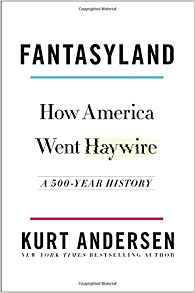
Fantasyland: How America Went Haywire: A 500 Year History, by Kurt Andersen. Random House, 2017


This is a very interesting, and, I think, valuable book to have come out at this time and place. Surveys he cites show that one fifth of Americans think the 9/11 attacks were an inside job by American government agents, and four fifths believe that the Bible is factual history right down to the creation story. Only a third of us believe that the current climate changes are human caused. Various religious sects believe all the others are heretic. The author states that between the 60s anything goes ideology, the huge show business influence, extreme religions, and the internet, the lines between reality and what we merely believe in have become very, very blurred. We put feelings and beliefs ahead of verifiable facts, in ways that people in the rest of the world don’t. And this loss of touch with reality brings us to the point where religious beliefs are being used to direct boards of education and medical care, and we elect politicians on what they say rather than what their voting record (or lack thereof) shows they’ve done.

American history, from the very first European settlers (barring the Vikings, who didn’t stick around), has been different from that of other countries. He goes through the details of why Americans are unique in how they see the world. He writes about not just religion and politics but immersive gaming and comic cons. (note to the author: I’ll go out on a limb and say that 99% of us who go to cons don’t believe we’re really vampires, in an alternate Victorian age where ray guns are powered by steam, or that we are capable of flying- it’s just *fun*)

The book is not overly long (over 400 pages) but it is a solid read. Despite the length and the deluge of facts, the author has an entertaining writing style that drew me in and made this a book I couldn’t put down. I think it’s an important subject to think about, and possibly reassess how our own beliefs influence our actions. Five stars


the above is an affiliate link. If you click through and buy something- anything- from Amazon, they will give me a few cents. 

I received this book free from the Amazon Vine program in return for a fair review. 

Neither of these things influenced my review. 

Tuesday, April 11, 2017

Cannibalism: A Perfectly Natural History, by Bill Schutt. Algonquin Books of Chapel Hill, 2017


People tend to think of cannibalism as something rare and weird and horrible. In fact, it’s pretty common. Pretty much every part of the animal world has cannibal species in it. We all know about the praying mantis female eating her mate, but lots of insects, spiders, fish, amphibians, and even mammals dine on either their spouse or their children. Sometimes the children eat the parents. Those mouth breeding fish? The ones where the male holds the brood of babies in their mouth while they mature? Yeah. Sometimes they get hungry and have a little snack. Mice eat their young in overcrowded conditions. Higher on the family tree, chimps and polar bears do it. Some sharks eat their siblings while they are still in the womb. Some creatures eat each other when there is food scarcity. Some creatures only eat parts of each other- there is one species that eats the lining of the mother’s uterus while still inside.

But it’s not just critters. Humans perform cannibalism, too, and it’s not just the Donner party and Hannibal Lector. Sometimes it is a matter of survival, like the Donner party and the survivors of the airplane crash in the Andes. The people are already dead; they aren’t killing them for food; they are just taking advantage of what is there so they can survive. That’s not the only time humans eat each other, though. Sometimes it’s done to honor the beloved dead- sort of grokking their loved ones. Most often, though, people eat only parts of each other. In the past in Europe, there were many ‘cures’ that involved things like powdered skulls and the blood from a hanged man being ingested. These days, some women eat their own placenta after giving birth. Most don’t tend to think of these cast off bits of humanity as being parts of people, but they are.

Then there is the issue of false accusations of cannibalism. It seems like an awful lot of indigenous people have been accused of this habit when they are inconvenient for conquerors. Want the tribe’s land? Just call them cannibals and it’s okay to kill them off; you’re just saving yourself from danger! It happened all over in the tropical American areas when the Spanish first came into the area.

Biologist Schutt takes a fairly light hearted look at cannibalism. He deals in both data and anecdote; the prose is a fast and easy read. His style of dealing with taboo subject matter reminded me of Mary Roach (“Stiff” and others); a very readable overview of something with big squick value. 


The above is an affiliate link. If you click through and buy something- anything- from Amazon, they will give me a few cents. 

I received this book free in return for an unbiased review from the Library Thing Early Reviewers program. 

Neither of these things influenced my review.