Showing posts with label Asian Americans. Show all posts

Saturday, February 16, 2019

Daughter of Moloka’I, by Alan Brennert. St. Martin’s Press, 2019


We first meet Ruth in an orphanage on Oahu, the half Japanese, half Hawaiian daughter of occupants of the Moloka’I leper colony. Over the course of 54 years, from 1926 to 1970, we follow her life as she is adopted by a Japanese family who move to California to farm. Of course, come Pearl Harbor, they are put in an internment camp and later have to start over in the aftermath. Ruth is contented with her life; she loves her parents and is starting a family of her own. Then, out of nowhere, a letter arrives from Rachel – her birth mother. Will Ruth want to meet the woman who gave her up when she was one year old? Can she love both her birth mother who she doesn’t remember and her adoptive mother, the only other she’s known? Can she even understand the woman who gave her up- and who lived a significant amount of her life in the leper colony?


The characters are mostly well drawn and three dimensional. The author brings places to life, too- the islands, central California, the internment camps. I think this description of the inhumanity of putting people in internment camps like animals comes at a time when the US is doing the same thing all over again, and I hope it will make some difference in the minds of readers. Five stars.

Thursday, December 20, 2018

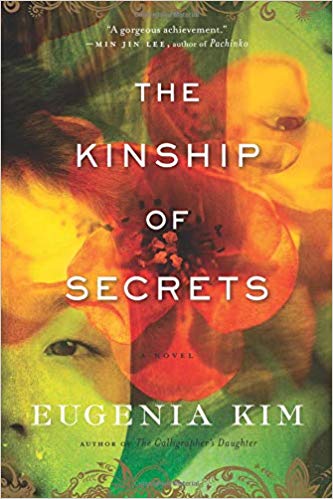
The Kinship of Secrets, by Eugenia Kim. Houghton Mifflin Harcourt, 2018


In 1948, a Korean family is split up. Najin and Calvin Cho want to go to the USA with their two daughters, but money is short and there is the issue of convincing the government that they intend to return. Leaving one daughter will solve both those problems, so they take baby Miran with them and leave Inja with Najin’s family. New born Inja doesn’t miss or remember them; to her, her uncle and aunt are parents. Her grandparents also share the house with them, so she has no lack of family.


When the Korean War breaks out, it makes the possibility of getting Inja out dimmer. Inja and her family find themselves running south from the North Korean troops, and spend time in a refugee camp with nothing to their names. It takes years for them to rebuild their lives again. Meanwhile, Najin sends packages to them every week with money, clothing, and other goods. She doesn’t know that Aunt and Uncle have to sell most of the goods to get enough money for food and necessities. The Chos work endless hours to afford a home in the suburbs as well, and Miran grows up as an American girl, albeit one who knows she is different.


It’s not until Inja is in high school that the Chos find a way to get her out. By then, Inja doesn’t want to go; she has friends, is doing very well in school, and she loves her Uncle and Aunt. She has no desire to see these people she doesn’t know; she speaks little English and her sister speaks no Korean. Miran is shaken by Inja’s arrival; suddenly she has to share everything including her room. Can two sisters so different find their way to love each other?


I loved this book. I felt great sympathy to all of them; they were all doing the best they could in bad situations. I held my breath to see how the sisters would do together; would they get along? Would they come to understand how the other had grown up? Would Inja grow to love her blood parents? The characters are easy to care about. The prose is wonderful. Five stars.

Monday, July 24, 2017

Sour Heart, by Jenny Zhang. Lenny, 2017


This collection of stories focuses on the experiences of Chinese immigrants in both China and America. They are loosely connected; characters from one story will be mentioned in another. These people do not have the nice house of the family in ‘Fresh Off the Boat’; the family in the first story at one point are sharing one room with 10 people; the room is just mattresses on the floor. Not to mention the cockroaches…. Other stories have the children left alone to take care of themselves because bother parents are working; in one, sexual exploration turns into sexual violence. One man whose lives in poverty with his wife and child has an endless string of mistresses. A grandmother claims to have breastfed her grandchildren, she loved them so much. A mother demands to be loved more than her husband, putting her child in an intolerable bind.

These are really grim stories. I had trouble finishing the book. I don’t demand all happy endings and unicorns farting rainbows, but there were no bright spots in these stories. Still, there are moments of laughter. Zhang writes with black humor that doesn’t lighten the mood but does make it survivable. I think I’m not sophisticated enough for this book. 


The above is an affiliate link. If you click through and buy something- anything- Amazon will give me a few cents. 

I received this book free from the Amazon Vine program in return for an unbiased review.

Neither of these things influenced my review.  
 

Saturday, July 8, 2017

Love and Other Consolation Prizes, by Jamie Ford. Ballantine Books, 2017


‘Love and Other Consolation Prizes’ covers more than 50 years. At one end, we have a five year old half Chinese/half white boy being sent by his starving mother to America. After a horrible voyage (children packed into the hold like animals; any who got ill were thrown overboard) and being placed in a few different places, he comes into the hands of Mrs. Irvine, who sponsors him at Holy Word school. When his year-end review comes up, he asks Mrs. Irvine if he could maybe go to another school or something rather than continuing at Holy Word. In an act that seems like retaliation, she takes him to the Seattle World’s Fair (actually called the Alaska-Yukon-Pacific Exposition), where many donated things are being raffled off, and donates *him*.

At the other end, we have the 1962 Seattle World’s Fair, with a brand new Space Needle and much more. The little boy is now Ernest Young, senior citizen, living in a flea bag hotel, with his wife, Gracie, being in a state of dementia. But her memories are starting to come back, and she is calming down. At the same time, one of their daughters, Judy (Juju), a newspaper reporter, is searching for a great story- and has discovered, via old newspapers, that her father was the boy who was raffled off. She wants his story. He’s reluctant to talk about it, for reasons that become obvious.

When Ernest was raffled off, the madam of Seattle’s finest brothel won him. At first glance this would seem to be a bad thing, but it’s not. For the first time he has enough to eat, and his own room. He’s treated well. He’s expected to work and earn his keep, but he’s not a slave. The other servants and the ‘upstairs’ girls are likewise well treated. Of course, the upstairs girls run the risks of the trade- disease and nasty customers. Nasty customers are barred forever, but nothing stops disease. Madam Flo is the stereotypical hooker with a heart of gold.

As soon as he is won by Madame Flor, he makes the acquaintance of two girls near his own age: one the daughter of the madam, Maisie (although identified to all as her sister); the other is Fahn, a Japanese scullery maid. It turns out he knows Fahn; she was on the same boatful of indentured servants that he was on. Ernest and the two girls become fast friends in the years that they are there.

It’s a heartbreaking story in some ways; in other ways it’s heartwarming. Ford has researched Seattle history; there really *was* a child raffled off at the AYP Expo, although that one was a baby. The brothels of Seattle of course were real, including one very high class one that bribed everyone that needed bribing to stay in business. The girls- many of them Asian- kept as slaves in the low class ‘cribs’ were real.

There is a good balance of well-developed characters, great description of scenes and events, and action. We’re seeing the beginning of the modern age- electric lights taking over from gaslights, automobiles showing up on the streets- and it’s an exciting time. Five stars out of five.


The above is an affiliate link. If you click through and buy something- anything- from Amazon, they will give me a few cents. 

I received this book free from the Amazon Vine program in return for an unbiased review. 

Neither of these things influenced my review.

Monday, September 19, 2016

The Fortunes, by Peter Ho Davies. Houghton Mifflin, 2016


“The Fortunes” is one novella and three short stories about Chinese-Americans and the problems they have- and still do- face.

“Gold” is set in Gold Rush era California, where young Ling has been sent by Big Uncle- the owner of a floating brothel in China who raised him after his Chinese mother died and his white father paid Uncle to take care of him- to labor in a laundry. From working as an opium boy in the brothel he’s picked up some English and other languages, so he has an advantage in America. He’s hired by Charles Crocker, founder of the Central Pacific Railroad which was the western portion of the Transcontinental Railroad, as a valet. Dressed in western clothing, his que cut off, and his hat slanted over his eyes he can pass as white in dim light. He’s moving up on the socio-economic ladder, and Crocker sees his gentility and submissiveness as evidence that the Chinese will make the ideal work force for the railroad, working for less money. This causes Ling to reexamine his identity and his loyalties.

“Silver” is about Anna Mae Wong, the first Asian Hollywood star, as she makes her only trip to China. The story is told in an odd format; short, choppy episodes. This should have been my favorite story, given my interest in old Hollywood, but I found the style off-putting. The story tells how she cannot get ahead; she can only get roles as a dragon lady villain or a young butterfly-like maiden. What should have been the role of her lifetime, the lead in “The Good Earth”, was given to a non-Asian actress. Miscegenation laws prevent her from having an onscreen kiss with any white actor. Her options are limited.

“Jade” is about the brutal murder of Vincent Chin; a hate crime perpetrated by auto workers laid off by the influx of Japanese imports thinking the Chinese-American Vincent was Japanese. The narrator is Vincent’s friend, thirty years later, the friend who was present at the killing but ran to safety. There is, of course, survivor guilt for him to deal with. Somehow, despite the horror of the killing, the intensity that you’d think would be there never makes it.

“Pearl” is about a Chinese-American man and his white wife going to China to adopt a baby girl. At home, he has always felt he stood out and didn’t fit in. Now, in China, he blends away into the crowds, but doesn’t feel Chinese enough.

All these stories are anchored by the question of Chinese-American identity, of having a foot in each culture. In these stories, even those born here have that quandary: to whom do I owe allegiance? There is also the continual problem of having to face prejudice.

In the end, my favorite story was “Gold” and I rather wished it had been made into a full novel. The characters are well developed and interesting, unlike those in the shorter tales. As a whole, the book is uneven. Four stars out of five.


The above is an affiliate link. If you click through and buy something- anything- from Amazon, they will give me a few cents. 

I received this book free from the Amazon Vine program in return for an unbiased review. 

Neither of these things influenced my review.