Showing posts with label American sociology. Show all posts

Saturday, December 15, 2018

Prius or Pickup? How the Answers to Four Simple Questions Explain America’s Great Divide, by Marc Hetherington & Jonathan Weiler. Houghton Mifflin Harcourt, 2018


Hetherington & Weiler put forth the theory that there are two types of people: fixed, and fluid. The fixed have a world view of danger: people and nature are out to get them. Fluid folks, on the other hand, find the world a delightful place to explore, filled with good people. Fixed people drive giant four wheel drive pickups or Hummers, keep big dogs, and prefer plain coffee from Dunkin Donuts over fancy Starbucks concoctions. Fluid folks drive small cars that are less damaging to the environments, like cats, and love trying new cuisines. Oh, and fixed people tend to live rural, while fluids congregate in the city. Most people are NOT pure forms of either, but land somewhere in the middle of the spectrum. Now, there is nothing wrong with being on either end of the spectrum, but… in America, these tendencies are being used by the major parties to divide people and gain support. This is what’s behind the growing chasm between Democrats and Republicans. The Republican Party stresses the dangers in the world, and that they are the only candidates that can protect the people of the USA; Democrats try to say they are supporting programs like the ACA that will benefit all classes. Now, this is a broad brush to paint the political/sociological scene with, but it seems, in most cases to be true.


And it’s getting worse- the two sides don’t get together very often. If the fixeds and the fluids worked together, partied together, went to school together, they would learn that the other side isn’t really the bunch of idiots they think they are. Hard to do when the Powers That Be try to demonize the other side.


Are they right about this? Yes, I think- partly. The chasm between sides is getting worse every day. And it’s obvious that the divide is being used by said Powers That Be. Is it quite as simple as that? Well, no, I don’t think so. There are a lot of other things affecting the world. But this book is a great start to understanding the problems. The one problem I see is that the authors are clearly biased towards one side; it happens to be the side I mostly fall into, but it’s going to make it harder for the side they are against to take the book seriously. Four stars.

Tuesday, August 22, 2017

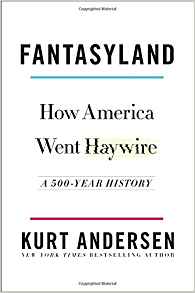
Fantasyland: How America Went Haywire: A 500 Year History, by Kurt Andersen. Random House, 2017


This is a very interesting, and, I think, valuable book to have come out at this time and place. Surveys he cites show that one fifth of Americans think the 9/11 attacks were an inside job by American government agents, and four fifths believe that the Bible is factual history right down to the creation story. Only a third of us believe that the current climate changes are human caused. Various religious sects believe all the others are heretic. The author states that between the 60s anything goes ideology, the huge show business influence, extreme religions, and the internet, the lines between reality and what we merely believe in have become very, very blurred. We put feelings and beliefs ahead of verifiable facts, in ways that people in the rest of the world don’t. And this loss of touch with reality brings us to the point where religious beliefs are being used to direct boards of education and medical care, and we elect politicians on what they say rather than what their voting record (or lack thereof) shows they’ve done.

American history, from the very first European settlers (barring the Vikings, who didn’t stick around), has been different from that of other countries. He goes through the details of why Americans are unique in how they see the world. He writes about not just religion and politics but immersive gaming and comic cons. (note to the author: I’ll go out on a limb and say that 99% of us who go to cons don’t believe we’re really vampires, in an alternate Victorian age where ray guns are powered by steam, or that we are capable of flying- it’s just *fun*)

The book is not overly long (over 400 pages) but it is a solid read. Despite the length and the deluge of facts, the author has an entertaining writing style that drew me in and made this a book I couldn’t put down. I think it’s an important subject to think about, and possibly reassess how our own beliefs influence our actions. Five stars


the above is an affiliate link. If you click through and buy something- anything- from Amazon, they will give me a few cents. 

I received this book free from the Amazon Vine program in return for a fair review. 

Neither of these things influenced my review.