Showing posts with label American history. Show all posts

Sunday, January 22, 2023


Over My Dead Body: Unearthing the Hidden History of America’s Cemeteries, by Greg Melville. Abrams Press, 2022

The title pretty much says it all. He gives the history of not just the cemeteries, but of the area in general, as well as who designed the graveyard and the people who are buried there. Each chapter of the book is about a different American cemetery, starting with colonial Jamestown and ending with Hollywood Forever, and then devoting chapters to cremation, green cemeteries, and the way that a person can stay “alive” indefinitely via computer files and the internet.

One thing that comes up repeatedly is how the American Way of Death (as Jessica Mitford named it a few decades ago) is a money making machine. The plot purchase, the coffin, the embalming, the services, the maintenance of the gravesite… it all adds up tremendously. And they don’t tell you that most of it isn’t necessary. You don’t need a mahogany and brass coffin that’s better made than many people’s furniture. You don’t need a concrete vault in most cases. Embalming isn’t required in most jurisdictions, unless the body is being held for over a certain amount of time. But it’s easy to lay a guilt trip on a grieving family- “It shows your respect for your father!” “Don’t you love your mother enough to buy the very best?”- and upsell them.

Another item that comes up several times is the utter disrespect for existing graves when the well to do or those in power (usually the same thing…) wanted to use the land for something else. The early white colonists rode roughshod over Native American graveyards, whether it was for building, their own graveyards, or for agriculture. The poor had their graveyards built over in more than one place. A graveyard for African-Americans in New York had Central Park built over it- the grave markers were moved, but the bodies weren’t.

The book is well written, presented as a travelogue; anywhere the author travels, he tries to call in at any graveyards in the area, especially well known ones. His family finds this rather tiresome, given that they don’t share his enthusiasm for cemeteries (Hollywood Forever was found more acceptable than most, but just barely). Anyone who likes to walk through graveyards will enjoy this book.


Saturday, January 5, 2019

Pocahontas and the English Boys: Caught Between Cultures in Early Virginia, by Karen Ordahl Kupperman. New York University Press, 2019


Most Americans have some vague recollection from school that Pocahontas was taken from her people to England. In fact, even as a 10 year old girl, she learned English quickly (as kids do) and served as translator and go between for her father. At least three English boys were given to the various tribes to absorb their languages and facilitate communications. For the most part, these exchange children were well treated, but there were many incidents where one side or the other told lies to the children, which they then carried to their hosts. It got so neither side trusted the children. As they became adults, their situations became even more suspect. Pocahontas of course married an Englishman and went to England, where she died, but the English boys had varied fates. In the conclusion, the author compares the children to Stockholm Syndrome sufferers, whereby they are put in a terrifying situation but then are treated with kindness by their captors.


While the book wasn’t difficult reading, the author goes into great detail about the actions of the colonists and the Native Americans, and I would sometimes become confused as to which group or person she was talking about. It’s a great book, though, for showing the kind of misleading things the English did to take advantage of the Native Americans, as well as the situations the colonists found themselves in, in an area with different plants and animals from what they were used to. Four stars.

Sunday, November 18, 2018

The General’s Cook, by Ramin Ganeshram. Arcade Publishing, 2018


Hercules Harkless was a real person; he was the chef for George Washington for many years. As a slave, he had privileges that most slaves didn’t;: he received a decent wage; as long as his work was done he could leave the premises and go to the tavern or the theater; and he wore beautiful clothing. But he was still a slave. He was prohibited from learning to read and write. Even though he spent a lot of time in Philadelphia, which had a law that said any slave that resided in the state for six months was free, this freedom was kept from him by the simple method of rotating him between the Philadelphia house and Mount Vernon every few months. There always existed the threat of being sold or whipped. His daughters were kept at Mount Vernon, keeping him away from them for months at a time.


Harkless ran the kitchen for Washington, although he was under the authority of white servants. He apparently was trained in France, and learned their methods of cooking. He also kept a spotless kitchen, and knew such things as washing the cutting board between working with meat and vegetables (I have no idea if these bits are backed up by history or not).


The story takes place between 1793 and 1797; in 1797, on Washington’s birthday, after preparing things and telling the other slaves what to do, he vanished, never to be found. I like to think that he gained his freedom. The story hints that a free black man set up a tavern that sold exceptional food in New York might have been him. Along with Harkless’s own story line, there are subplots. One is of his oldest son Richmond, who worked under him in the kitchen but did not show an aptitude for the job. Another line is Nate, a young slave who *does* show a talent for cooking, and his relationship with Margaret, a teenaged indentured servant (a temporary slavehood for poor white people). Threaded all through the story is the tension that all slaves lived under, of not being in charge of their lives.


I enjoyed the story although at times it seemed to wander a bit. The author’s ability to describe things, whether sites in Philadelphia, Harkless’s fancy clothing, or- especially- the food he cooks is just exquisite. I was hungry the whole time I was reading because of the food descriptions! The writing in general, though, was a bit rough in places. A number of the supporting cast are not given enough depth. The most important thing, though, is the struggle between being a man who is free to go to the theater with white people and buy nice clothes, while at the same time always being under the whim of his owners, and this is painted vividly. Five stars. 

I received this book free from the Amazon Vine program in return for an unbiased review. This did not alter my opinions. 

Tuesday, August 22, 2017

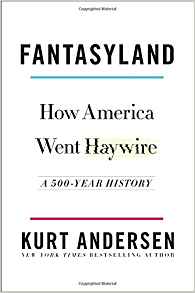
Fantasyland: How America Went Haywire: A 500 Year History, by Kurt Andersen. Random House, 2017


This is a very interesting, and, I think, valuable book to have come out at this time and place. Surveys he cites show that one fifth of Americans think the 9/11 attacks were an inside job by American government agents, and four fifths believe that the Bible is factual history right down to the creation story. Only a third of us believe that the current climate changes are human caused. Various religious sects believe all the others are heretic. The author states that between the 60s anything goes ideology, the huge show business influence, extreme religions, and the internet, the lines between reality and what we merely believe in have become very, very blurred. We put feelings and beliefs ahead of verifiable facts, in ways that people in the rest of the world don’t. And this loss of touch with reality brings us to the point where religious beliefs are being used to direct boards of education and medical care, and we elect politicians on what they say rather than what their voting record (or lack thereof) shows they’ve done.

American history, from the very first European settlers (barring the Vikings, who didn’t stick around), has been different from that of other countries. He goes through the details of why Americans are unique in how they see the world. He writes about not just religion and politics but immersive gaming and comic cons. (note to the author: I’ll go out on a limb and say that 99% of us who go to cons don’t believe we’re really vampires, in an alternate Victorian age where ray guns are powered by steam, or that we are capable of flying- it’s just *fun*)

The book is not overly long (over 400 pages) but it is a solid read. Despite the length and the deluge of facts, the author has an entertaining writing style that drew me in and made this a book I couldn’t put down. I think it’s an important subject to think about, and possibly reassess how our own beliefs influence our actions. Five stars


the above is an affiliate link. If you click through and buy something- anything- from Amazon, they will give me a few cents. 

I received this book free from the Amazon Vine program in return for a fair review. 

Neither of these things influenced my review. 

Sunday, October 9, 2016

City of Dreams: The 400-year Epic History of Immigrant New York, by Tyler Anbinder. Houghton Mifflin Harcourt, 2016


History professor Anbinder, himself a native of New York, traces the waves of immigrants that have built NYC into the behemoth it is today. From Peter Minuit and his deal with the Native Americans to today, the author follows wave after wave of immigrants and how they shaped the city. From the Puritans and fur traders to huge waves of German and Irish immigrants to the Italians, eastern Europeans, Asians, former slaves, South and Central American, and West Indies, all the big movements of people are here. It’s a fascinating read; every wave of people came over hoping for more opportunity and a new life. Nearly all faced prejudice of the already ensconced people, horrible living conditions, and endless hard work. They bore this steadfastly, all in the hope that their children would have better lives than they had.

This is not your boring history book. Anbinder frequently uses personal accounts to bring vivid life to the past. While this is a massive book- nearly 600 pages with another 100 of end notes, bibliography, appendices, and index- it was as gripping as a well-written novel. Here’s the Irish fleeing the famine, arriving as stick figures. Here are the people trying to take advantage of new immigrants. There were some parts that were less interesting to me- the section on the Civil War, for instance, because I never find war interesting- even those I read every word of. That is a first for me; I tend to skip the bits about fighting.

Every wave of immigrants seemed to follow the same routine: take the first jobs they could get, always the things natives (and previous immigrants) had risen above. They work 7 days a week (except for the Jews, who mostly didn’t work on the Sabbath). They live in cramped quarters. As soon as they can save the money, they start a business of their own. They also send amazing amounts of money back to their home countries, whether it be to support parents or to bring over other family members. They become citizens as fast as possible most of the time, unless they are hoping to make enough money to have a business in their home country. They almost always dislike the next wave of immigrants, feeling that next wave has a criminal element to it. Humans have remained the same for the 400 year span of NYC; they are filled with prejudice.

Excellent book; should be required reading. It’ll enlighten a lot of folks who want to build a wall. 


The above is an affiliate link. If you click through and buy something- anything- from Amazon, they will give me a few cents. 

I received this book free from the Amazon Vine program in return for a fair review. 

Neither of these things influenced my review.